

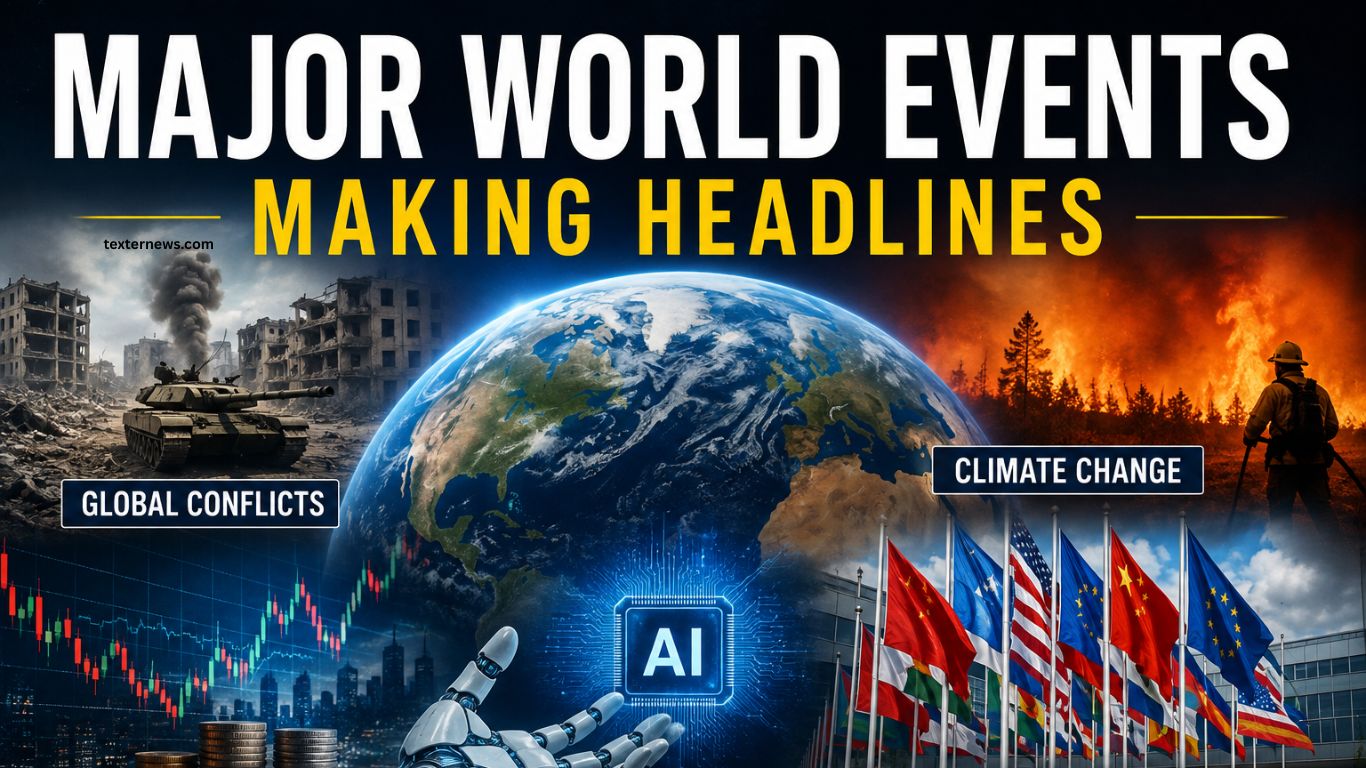
Major world events continue shaping international politics, economies, communities, and everyday life. From geopolitical tensions and climate emergencies to economic uncertainty, technological progress, and major international gatherings, global developments are moving rapidly. Understanding these events helps readers recognize how decisions made in one region can influence people across the world.
Current headlines show a world facing complex challenges while also experiencing important scientific, economic, and technological changes. Recent reporting highlights growing climate risks, geopolitical pressure, financial uncertainty, and major diplomatic developments.
Read More: Breaking News That Could Impact Millions Worldwide
Global Conflicts and Geopolitical Tensions
Geopolitical tensions remain among the most closely watched developments worldwide. Ongoing conflicts continue affecting international relations, energy markets, trade routes, and humanitarian conditions.
The continuing Iran war has placed additional pressure on global markets, particularly because disruptions around the Strait of Hormuz have contributed to higher energy costs. Financial markets remain sensitive to developments connected with the conflict and wider international security concerns.
The situation demonstrates how regional conflicts can create consequences far beyond national borders. Higher energy prices can influence transportation, manufacturing, food costs, inflation, and household budgets. Governments and international organizations continue monitoring these developments as they assess their potential effects on global stability.
Climate Change Becomes a Growing Global Concern
Climate change remains one of the biggest long-term challenges facing the international community. Scientists are increasingly concerned about extreme heat, flooding, droughts, wildfires, and rapidly warming oceans. Recent reports indicate that the world’s oceans reached their hottest recorded average surface temperature in August 2026, highlighting the continuing effects of global warming.
Europe is also experiencing an exceptionally severe summer. Recent estimates indicate that consecutive heatwaves have contributed to tens of thousands of excess deaths across Europe, although figures remain provisional as several countries continue reporting data.
These developments demonstrate that climate change is no longer viewed only as a distant environmental issue. Extreme weather increasingly affects public health, agriculture, infrastructure, energy demand, water supplies, and economic stability.
The Threat of Extreme Weather
Scientists are also watching the development of a potentially powerful El Niño event. Forecasts suggest that the 2026–27 El Niño could become exceptionally strong, potentially influencing weather patterns across multiple continents. El Niño can contribute to unusual rainfall, drought, heat, storms, and other disruptions depending on regional conditions.
The possibility of more intense climate-related events has increased pressure on governments to strengthen disaster preparation. Better forecasting, resilient infrastructure, emergency planning, and environmental protection can help communities reduce the impact of future disasters.
Global Economy Faces Continued Uncertainty
Economic developments remain another major part of international headlines. Central banks are closely monitoring inflation, interest rates, energy costs, and economic growth. Financial markets are also reacting to geopolitical developments and expectations surrounding monetary policy.
Investors are paying particular attention to central-bank decisions and major economic indicators as policymakers attempt to control inflation without damaging economic growth. Global energy prices remain an important factor because higher fuel costs can increase expenses across transportation, manufacturing, and consumer markets.
Artificial Intelligence Continues Changing Technology
Artificial intelligence remains one of the most influential technology trends worldwide. AI is transforming business operations, software development, education, content creation, healthcare research, and financial services.
The technology sector continues to watch major AI companies and semiconductor manufacturers closely because demand for advanced computing hardware remains connected to the rapid expansion of AI applications. Nvidia’s upcoming earnings are receiving significant attention from investors as markets assess the strength of AI-driven growth.
AI development also raises important questions about employment, privacy, cybersecurity, misinformation, and responsible technology use. Governments and businesses are increasingly working to balance innovation with appropriate safeguards.
International Diplomacy and Economic Cooperation
International diplomacy remains essential as countries attempt to address security, economic, and environmental challenges. Major international meetings provide opportunities for governments to discuss trade, investment, financial stability, climate policy, and global development.
The upcoming G20 gathering in the United States is expected to bring finance ministers, economic leaders, and business representatives together for discussions about global economic priorities. The event also highlights how international cooperation can support regions recovering from major disasters.
Science, Space, and Global Innovation
Scientific progress continues creating positive developments alongside global challenges. Space exploration remains an important area of international competition and cooperation, with countries investing heavily in lunar missions, advanced spacecraft, satellites, and scientific research.
The global technology race is also expanding beyond traditional computing. Advances in artificial intelligence, robotics, renewable energy, biotechnology, and space technology are creating new possibilities for future industries.
These developments could influence communication, transportation, healthcare, energy production, and scientific discovery during the coming decade.
Why Global Events Matter to Everyday People
Major world events can appear distant, yet their effects often reach ordinary households. International conflicts can influence fuel prices. Climate events can affect food supplies and electricity demand. Economic decisions can influence borrowing costs and employment. Technological developments can change how people work and communicate.
Following reliable international news helps people understand these connections. It also makes it easier to distinguish meaningful developments from temporary online trends and misinformation.
The Changing Global Landscape
The world is entering a period defined by rapid change. Geopolitical competition, climate pressure, technological innovation, economic uncertainty, and international cooperation are developing simultaneously. Recent headlines demonstrate how closely connected these issues have become.
The coming months could bring important developments across diplomacy, financial markets, climate policy, technology, and international security. Staying informed through credible sources remains one of the best ways to understand these changes and their potential impact.
Frequently Asked Questions
What are major world events?
Major world events include conflicts, climate developments, economic changes, technological breakthroughs, and important international decisions.
Why are global conflicts important?
Global conflicts can affect international security, energy prices, trade, economies, and humanitarian conditions worldwide.
How does climate change affect people?
Climate change can increase extreme weather, heatwaves, flooding, droughts, food risks, and pressure on public infrastructure.
Why is artificial intelligence making headlines?
AI is rapidly changing business, education, healthcare, software, communication, and many other industries.
How do global events affect the economy?
International events can influence inflation, energy prices, financial markets, trade, employment, and consumer spending.
Why should people follow world news?
Following reliable world news helps people understand major developments and their potential impact on everyday life.
Conclusion
Major world events continue influencing global society in powerful ways. Conflict, climate change, economic uncertainty, technological innovation, and international diplomacy are shaping the current global landscape. Recent developments show that events in one part of the world can quickly affect economies, communities, and policies elsewhere. By following reliable news and understanding the broader context behind major headlines, readers can gain a clearer view of the forces shaping the world today.

1 Comment
Pingback: Top Business and Political News Updates Today - TexterNews